Did You Know

Rejected Songs Turned Global Hits

Here are instances where one artist’s pass became another’s global smash; Rihanna’s “Umbrella” Producer Tricky Stewart confirmed that the track was shopped around before Rihanna recorded it. Among the artists it was first pitched to included Britney Spears and Mary J. Blige who both turned it down before Rihanna grabbed it and made a breakout smash out of it. “Shape of You” originally for Rihanna Ed Sheeran confirmed that the song was originally written with Rihanna in mind during the writing sessions for ÷ (Divide), but he ended up keeping it and releasing it himself. Truthfully, the song’s vibe and lyrical idea fit what he imagined for her.Britney Spears’ anthem “…Baby One More Time” offered to TLC and others first Max Martin and his team initially pitched the demo to groups like TLC and the Backstreet Boys, and even the UK boyband Five passed on it but they all rejected it before it landed with Britney Spears, who made it a global phenomenon. This is a testament to the fact that hits often have a wild history as many songs written for one artist but rejected eventually turned into career-defining hits for another artist.
Read More

Music Licensing and Sync Deals: The Hidden Goldmine Artists Are Finally Tapping Into

Most people think streaming is where artists make their money, but the real fortune actually lies behind the scenes of music licensing and sync deals. This is evident in the context of Afrobeats artists like: • Tems – “No Woman, No Cry” (Black Panther: Wakanda Forever)Her emotional delivery on the song helped define the movie’s tone hereby landing her massive licensing payout plus global attention. • Rema – “Calm Down”Beyond being a hit, Calm Down has been licensed for international ads and campaigns. This means more money for the young Afrobeats talent. • Burna Boy – “Destiny”Featured on Barack Obama’s playlist and multiple documentaries, showing how African music is being woven into global storytelling, Burna Boy is making making money off that track due to sync deals. How It Works • Music Supervisors Search for a Track: A film or brand looks for the perfect sound. • License Negotiation: The artist, label, or publisher agrees to terms and usage. • Payment: The artist receives an upfront sync fee, and continues to earn royalties whenever the song airs. • Split Between Rights Holders: Both the writer/publisher and the recording owner (often the label) get paid. That’s why owning your masters is such a big deal, it means you control your licensing income. Key Takeaways for Artists • Register with a Performance Rights Organization (PRO) like ASCAP, BMI, PRS, or COSON. • Add your songs to sync libraries like Artlist, Musicbed, or Epidemic Sound. • Keep an instrumental version of each track ready — many syncs prefer vocals light or clean. • Build relationships with music supervisors; they’re the gatekeepers to placements. The drill is, music licensing isn’t just about exposure, it’s a career game-changer. From Lagos to Los Angeles, artists are realizing that one song in the right film or ad can make more than a million streams ever will. In today’s music economy, as an artist, your next big break might not be a hit single, it might just be a sync deal. Written by Alaro Basit
Read More

Jimi Hendrix and the Flaming Guitar

Jimi Hendrix and the Flaming Guitar The Monterey International Pop Festival, California, 1967. This was to be Hendrix’s one shot at a breakthrough in the U.S as he was only mostly making waves in the UK. Also, considering the fact that the festival also featured huge rock names like Janis Joplin, Otis Redding and The Who who happened to be his agelong rival, Hendrix knew he had to do something spectacular to stand out since The Who already left an impression by smashing their guitars on stage just before Jimi’s performance came up. How the insanity unfolded • Hendrix had already lerformed an electrifying set that already had the crowd crazy and buzzing. • At the finale, he carefully set his guitar down, doused it in lighter fluid, and set it ablaze. • But he didn’t just light it and walk away, he knelt down with it and coaxed the flames as if in a ritual, hereby creating one of the most iconic images in music history. • When questioned about it, Hendrix said he already had it planned out after the altercation backstage with The Who about who is to perform first • A coin was tossed in favour of The Who after which Hendrix began hunting around backstage for some lighter fluid. • As Hendrix would later explain: “I decided to destroy my guitar at the end of a song as a sacrifice. You sacrifice things you love. I love my guitar.” How this carved him a legacy • The guitar itself, a 1965 Fender Stratocaster became a priceless piece of music history as it was later valued for thousands of dollars. • Hendrix’s fiery act became one of the most iconic moments in rock history, marking the moment he arrived as a legend.
Read More

Hans Landa – Inglourious Basterds

Christoph Waltz’s performance as Colonel Hans Landa in Quentin Tarantino’s Inglourious Basterds (2009) is considered one of the greatest villain portrayals in modern cinema as far as alternate history and the world war two is concerned. The drill about the language aspect: • Hans Landa speaks four languages in the film: German, French, English, and Italian. • Waltz was already fluent in German, English, and French before filming. • But for the Italian scenes (where Landa mocks the Basterds’ disguises), he learned just enough to deliver his lines convincingly. • Tarantino attested that it felt like Waltz was a “gift from God” because the role required one actor who could deliver flawlessly in multiple languages. • Before Waltz auditioned, Tarantino admitted that he feared the film might collapse because no one else could pull it off. • This multilingual performance earned Waltz’s the Academy Award for Best Supporting Actor, BAFTA Award, Golden Globe Award and the Cannes Best Actor which he actually won even before the film hit global release. • For Waltz, the role was career-changing as he was predominantly known as a TV actor in Europe before he starred in Inglourious Basterds.
Read More

The World’s Largest Music Festival – The Donauinselfest

The Donauinselfest (Danube Island Festival) Bigger than any Coachella, Glastonbury, or Rock in Rio, what makes the Donauinselfest wild is that unlike festivals such as Coachella or Glastonbury which cost hundreds of dollars per ticket and host under 200,000 people, Donauinselfest is completely free. Key Notables • The festival is held on Danube Island which is a long stretch of land in the middle of the Danube River. • It features dozens of stages covering everything from rock and pop to jazz, EDM, and folk. • Major international stars like Shakira, Robbie Williams, and Bob Dylan have performed there, alongside local Austrian acts. • To put it in perspective — 3.3 million people is larger than the entire population of Jamaica or Qatar, all partying on a single island for three days! The last Donauinselfest took place from June 20th to 22nd, 2025 while the next one takes place from July 3rd to 5th, 2026 to avoid clashing with the Austrian Grand Prix. So if you’re opportuned, you can add up to its already massive attendance!
Read More

Music Fun Facts – Kanye West’s Surgery

That’s right! On the 23rd of October, 2002, while driving back home from a late studio session in Los Angeles, Kanye West dozed off behind the wheels and collided head-on with another moving vehicle. This landed him a shattered jaw in three different places, difficulty in speaking due to the excruciating pain and a jaw almost slammed shut by doctors as a form of treatment and reconstructive surgery. But here comes the brain-burster! • Instead of resting and waiting to heal. Kanye started writing “Through the Wire” just 3 three days after the accident and went back to the studio just two weeks after to record the track. • With a jaw wired shut, Ye still went ahead to record “Through the Wire” with his mouth barely opening. • The song samples Chaka Khan’s “Through the Fire” and buttresses Kanye’s point of making art even when physically broken. • The track became the launchpad for his career as it convinced his label, Roc-A-Fella Records, to allow him to release his debut solo album titled The College Dropout (2004). • In turning a near-death experience into music that turned the tables of Hip-hop forever, Kanye’s feat forever goes down as a practical example of passion overriding pain.
Read More

Music Fun Fact – Frisson

What is Frisson? Frisson is a French word that translates to “shivers ” or “thrills” and it refers to that intense, goosebump-inducing feeling you get when music suddenly hits hard — like when the beat drops, when the choir swells, or when a singer hits a mind-blowing note. What is the Science Behind this? When frisson happens, it’s simply your brain releasing dopamine — the same chemical tied to reward, motivation, and pleasure. What Triggers It? It is usually triggered by sudden changes in musical dynamics i.e, sudden loudness, unexpected harmonies or key changes. Emotional vocals that sound raw or vulnerable & lyrics that resonate deeply with your personal life may also trigger frisson. N.B – It should however be noted that not everyone experiences frisson. Studies show that only about two-thirds of people get it from music, and those who do often have stronger connections to art, higher levels of empathy, or more active brain pathways linked to emotion. Takeaway lesson In essence, frisson shows us that music isn’t just entertainment, but also biological and universal. It proves that sound can move us on a chemical, physical, and emotional level.
Read More

Did You know

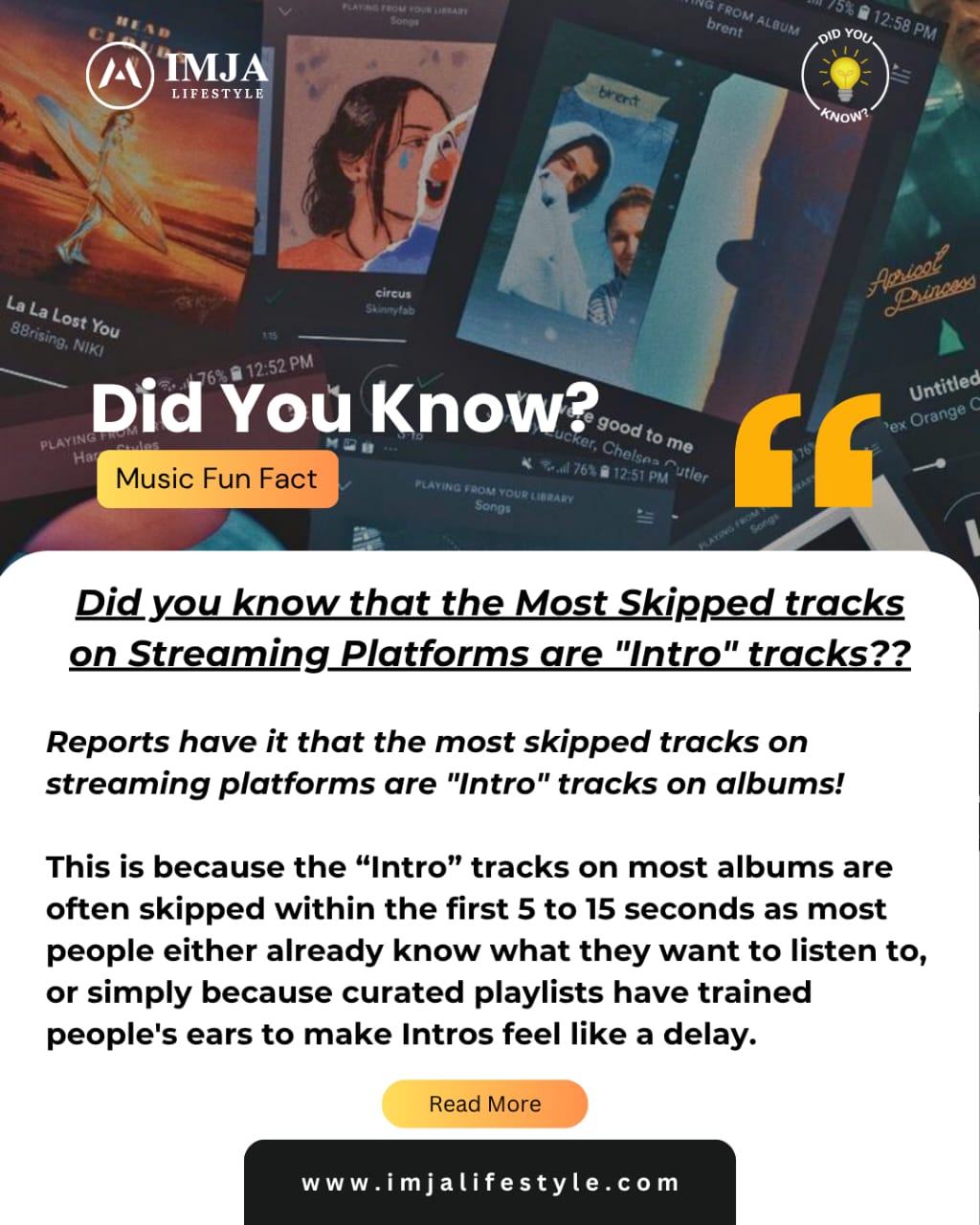
Did You know Most Skipped Tracks on streaming platforms That’s right, “Intro” tracks on most albums are the most skipped track — often within the first 5 to 15 seconds. Infact, many Afrobeats albums include skits or spoken-word intros that fans skip in favor of the vibe-heavy tracks. This happens because of one or more of the reasons spelt put below: • Listeners Are ImpatientPeople nowadays stream music like their going through a TikTok page. Hence, one a track doesn’t hook immediately, they skip. Intro tracks however falls into this category as most intro tracks are usually slow builds, instrumentals, or spoken word. Most people want instant energy or emotion. • Intros that don’t immediately feature the artist’s voice.An example is “Start” on Asake’s Lungu Boy. • People Already Know What Song They WantMost listeners already have an idea what they want to listen to either through tiktok, radio or playlists so they just skip the intro. • Playlists Have Trained Our EarsWe’ve become used to curated playlists with back-to-back bangers that intros now feel like a delay or unwanted part of the gem. @Alaro Basit
Read More

Did You Know

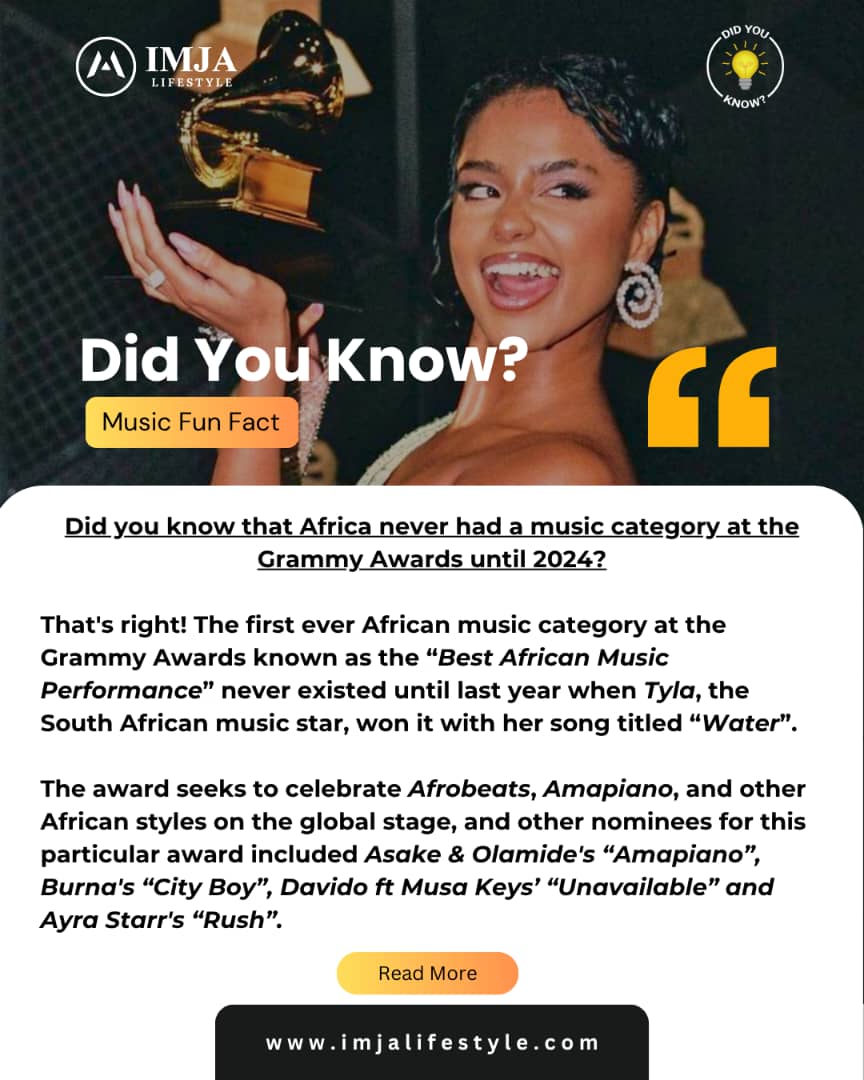
.Did you know that Africa never had a music category at the Grammy Awards until 2024? That’s right! The first ever African music category at the Grammy Awards known as “Best African Music Performance” never existed until last year when Tyla, the South African music star, won it with her song titled “Water”. The award seeks to celebrate Afrobeats, Amapiano, and other African styles on the global stage, and other nominees for this particular award included Asake & Olamide’s “Amapiano”, Burna’s “City Boy”, Davido ft Musa Keys’ “Unavailable” and Ayra Starr’s “Rush”. This matters a lot because it is the first Grammy award category to be dedicated specifically to African music and it purports to celebrate African music genres including Afrobeats, Amapiano, Afro-fusion, Highlife, Gqom and the likes.  It doesn’t look like much but it marks the formal recognition of Africa’s cultural and economic influence in global music. Overtime, African artists had been dominating streaming charts, and selling out concerts but never had a global music award of their own until 2024. It should however be noted that some African artists, like Wizkid and Burna Boy, had already won Grammys before this category existed. @Alaro_Basit
Read More

Did You Know

Did you know that Africa never had a music category at the Grammy Awards until 2024? That’s right! The first ever African music category at the Grammy Awards known as “Best African Music Performance” never existed until last year when Tyla, the South African music star, won it with her song titled “Water”. The award seeks to celebrate Afrobeats, Amapiano, and other African styles on the global stage, and other nominees for this particular award included Asake & Olamide’s “Amapiano”, Burna’s “City Boy”, Davido ft Musa Keys’ “Unavailable” and Ayra Starr’s “Rush”. This matters a lot because it is the first Grammy award category to be dedicated specifically to African music and it purports to celebrate African music genres including Afrobeats, Amapiano, Afro-fusion, Highlife, Gqom and the likes. It doesn’t look like much but it marks the formal recognition of Africa’s cultural and economic influence in global music. Overtime, African artists had been dominating streaming charts, and selling out concerts but never had a global music award of their own until 2024. It should however be noted that some African artists, like Wizkid and Burna Boy, had already won Grammys before this category existed. @Alaro_Basit
Read More

No products in the cart.